Few villains have shaped how writers think about antagonists as much as the Joker in The Dark Knight (2008). Written by Jonathan Nolan and Christopher Nolan, from a story by Christopher Nolan and David S. Goyer, the film follows Batman, Lieutenant Jim Gordon and district attorney Harvey Dent as they try to break organized crime's grip on Gotham, only for a stranger with no name and no history to turn the city upside down. Heath Ledger's performance earned him a posthumous Academy Award, but it was the writing that gave him something to perform.
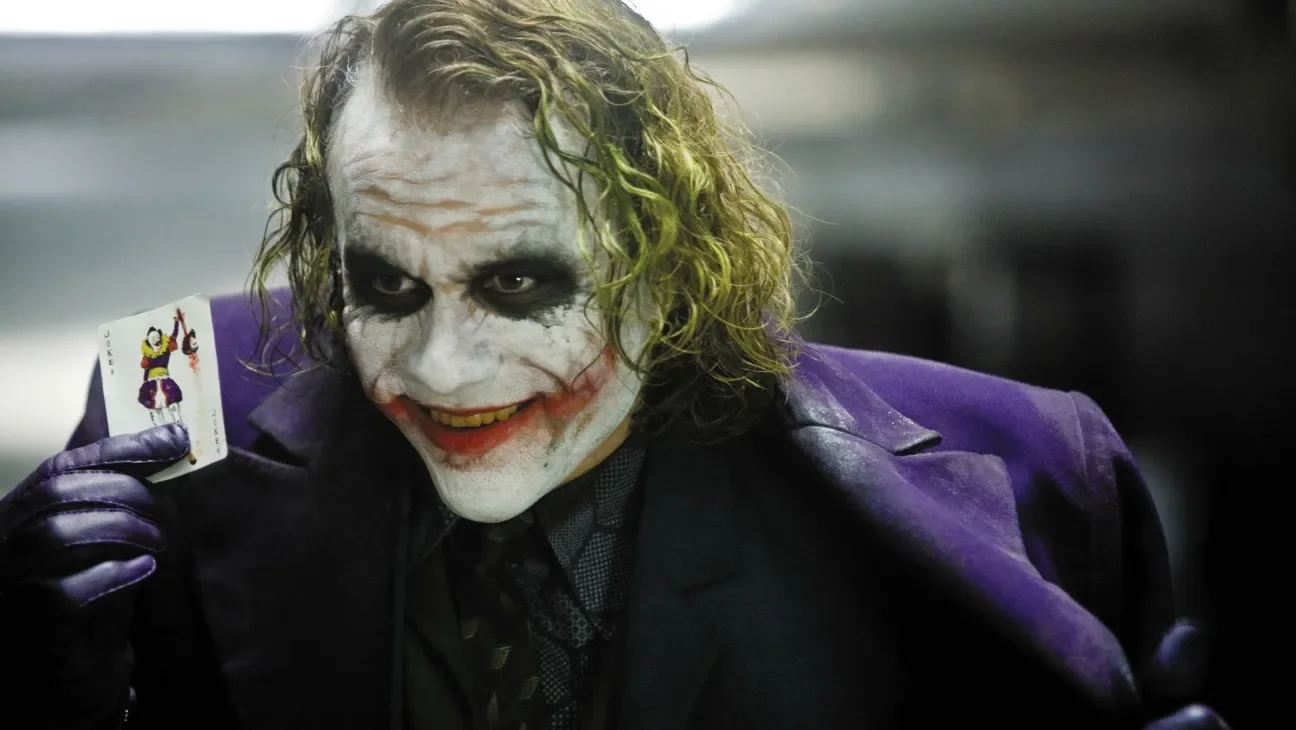
Still from 'The Dark Knight' (2008). Photo credit: Warner Bros. Pictures
What makes the film worth studying is that it never gives Batman a single enemy. It gives him three, and each one attacks a different part of who he is.
The Joker: A Villain Without a Past
The film refuses to explain him. He offers at least two different stories about how he got his scars, and neither can be trusted. Many writers feel pressure to hand a villain a tragic backstory so the audience can understand him. The Nolans do the opposite, and the absence of a past is exactly the point.
Alfred sets this up early. He tells Bruce about a bandit in Burma who stole precious stones only to throw them away, and he concludes that some men are not after anything logic can explain. That one story works as the thesis for the character, and it arrives long before the Joker's plan reaches its peak.
The lesson is that an antagonist who cannot be bought, threatened or reasoned with is a problem the hero's usual methods cannot solve. Notice, too, that the Joker's behavior only looks random. In every scene he has a clear purpose, which is why he feels unpredictable and controlled at the same time.
An Attack on the Hero's Rules
Batman has one line he will not cross, and the Joker spends the whole film pushing him toward it. He builds situations where every option costs someone's life, and he makes Batman feel responsible for deaths he did not cause.
A strong antagonist does more than block the protagonist's goal. He tests the protagonist's code. Batman's goal is simple: stop the Joker. The more interesting question is what Batman is willing to become in order to do it. The film plants this early with the surveillance system that turns every phone in the city into a listening device. Lucius Fox accepts it only on the condition that it is used once, and the discomfort on his face tells us that Batman is already bending his own principles.
The Interrogation Room
The Joker lets himself be caught. That choice sets up one of the best scenes in the film, because it flips the situation we expect. The hero finally has the villain alone in a room, and it is the hero who loses control.
Batman uses violence and the Joker laughs at it, because the beating tells him exactly what he wanted to know: Batman is angry, and Batman needs something from him. The Joker then offers a choice between saving Rachel and saving Harvey, and he has quietly swapped the addresses so that Batman's instinct leads him to the wrong place. Rachel dies, and Harvey survives, scarred.
For writers, the takeaway is to put your antagonist in a place where the hero holds every advantage and let the antagonist win the scene anyway. It shows the audience that the real power in the story lies somewhere other than where they expected.
Harvey Dent: The Antagonist Made From an Ally
Harvey Dent is introduced as Gotham's best hope, the honest face that could let Batman retire. The screenplay takes care to make us like him. He is charming, ambitious and brave enough to stand up to the mob in public. His coin toss, a small character detail early on, becomes the symbol of his fall. It is a textbook setup and payoff.
When Rachel is killed and Harvey is disfigured, he becomes Two-Face, and the story turns the hero's greatest hope into a threat. What makes this work is that the Joker never forces Harvey to change. He visits him in the hospital and gives him a push, then lets Harvey's own grief and anger do the rest. The most frightening kind of villain is the one who only needs to find the crack that was already there.
The Ferry
Late in the film the Joker rigs two ferries, one carrying ordinary citizens and the other carrying prisoners, each holding the detonator for the other boat. It is his experiment, designed to prove that people will turn on one another when the stakes are high enough.
The scene works because the story answers him. Neither boat presses the button, and the Joker's theory about human nature is tested and fails. Whenever your villain has a philosophy, the story has to respond to it, either by proving it or by disproving it. Here the film does both. The Joker loses on the water but wins with Harvey, so his argument is only half defeated, and that is why the ending feels honest rather than tidy.
The Mob and the Old Order
The film begins with the kind of antagonists Batman has always faced. The mob bosses are organized, greedy and used to being the most dangerous people in the room. Then the Joker walks into their meeting and offers to kill Batman for half of their money, and we watch them realize that they are out of their depth.
This is a smart way to show escalation. Instead of telling us the Joker is more dangerous than the criminals Batman has already beaten, the script lets those criminals look nervous. Later, when he burns a mountain of their cash, the scene confirms that money, which drives almost every other villain, means nothing to him.
Why the Ending Works
By the end, Batman has captured the Joker, but he has not won. Harvey is dead, and the city's hope is built on a story that would collapse if people knew the truth. Batman chooses to take the blame for Harvey's crimes so that Gotham can keep believing in its white knight.
That decision is a direct product of the antagonists' work. The Joker made the hero face the limits of his code, and Harvey showed what happens when hope goes wrong. The ending feels earned because every antagonist leaves a mark on the final choice.
Final Thoughts
The Dark Knight shows that a great antagonist is more than an obstacle. The Joker attacks Batman's rules, Harvey embodies the cost of failure and the mob shows how much the world has changed. Together they push the hero toward a decision he could never have made at the start of the film.
For your own scripts, try giving your antagonist a way to challenge your hero's beliefs rather than just their plans. Spread the opposition across more than one character, give your villain a theory and let the story test it, and remember that not every villain needs a backstory. Sometimes the most unsettling thing you can write is a person the hero cannot explain.