Most films make it easy to identify the villain. Parasite (2019) does not. Bong Joon Ho's film, which he co-wrote with Han Jin-won, follows the struggling Kim family as they work their way into the lives of the wealthy Park family by posing as unrelated, highly qualified employees. It won the Palme d'Or at Cannes and became the first film not in English to win the Academy Award for Best Picture, while also winning Best Original Screenplay.
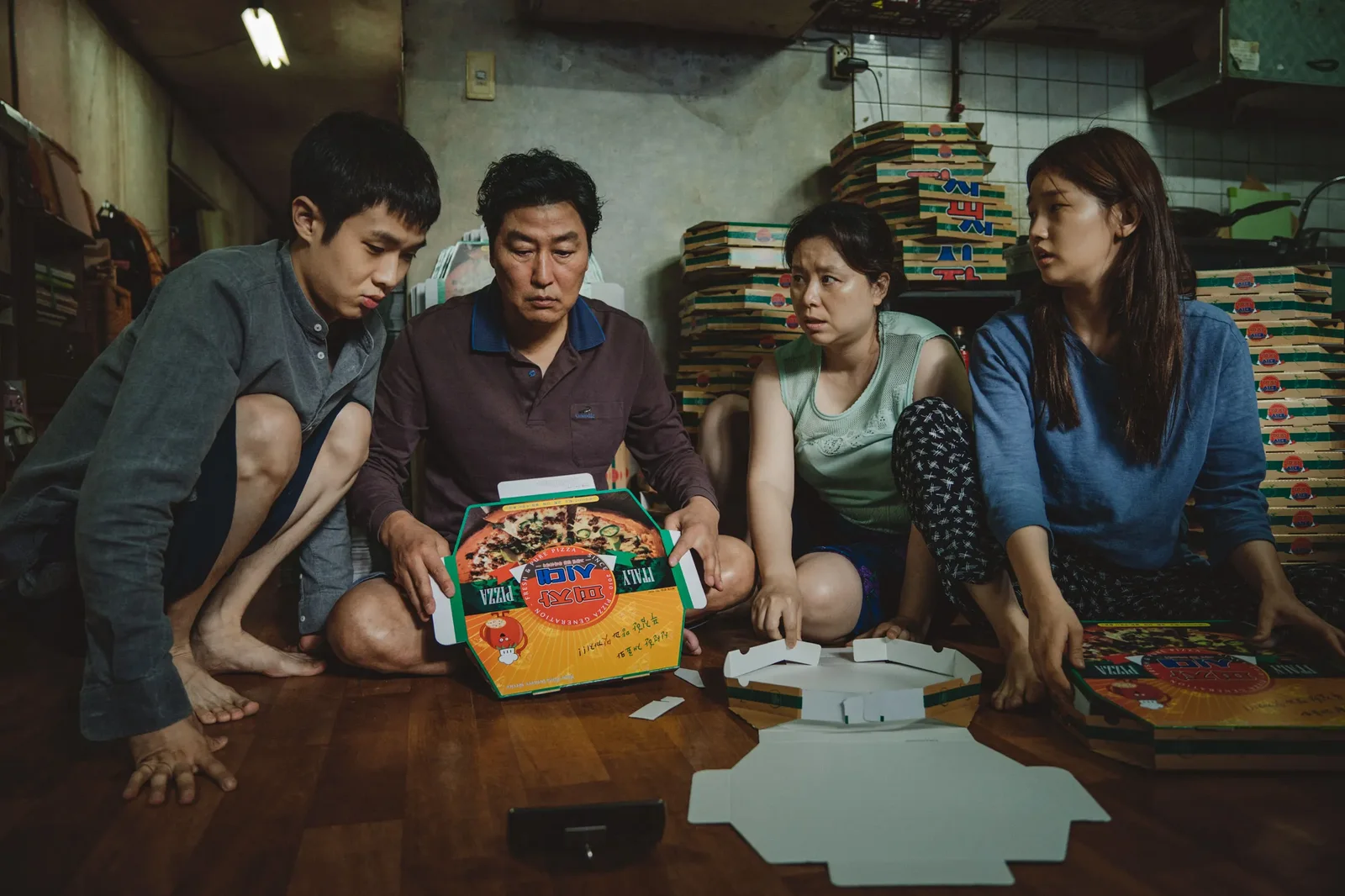
Still from 'Parasite' (2019). Photo credit: CJ Entertainment / Neon
What makes the film so fascinating from a writing perspective is how it spreads antagonism across almost every character, and then reveals that the real enemy is something none of them can fight directly.
The Kims: Protagonists Who Deceive
The audience follows the Kims, and it is hard not to root for them. They are clever, funny and desperate, living in a cramped semi-basement apartment and folding pizza boxes to get by. When the son, Ki-woo, is offered a job tutoring the Parks' daughter, the family sees an opportunity and takes it.
Yet their methods are ruthless. To secure jobs for the rest of the family, they push out the Parks' driver and their longtime housekeeper, Moon-gwang, through lies and manipulation. The screenplay invites us to enjoy the cleverness of their scheme while quietly showing the people who are harmed by it. The Kims are protagonists, but they are also antagonists to everyone in their way.
The Parks: Kindness Without Understanding
The Parks are not cruel in any obvious sense. They are polite, trusting and generous with their money. Mrs. Park is easily led, and Mr. Park is concerned mostly with his employees not crossing a line that he never clearly defines.
Their antagonism comes from what they do not see. Mr. Park repeatedly mentions the smell of his driver, a comment that seems minor but cuts deeply. To him, it is a passing observation. To Ki-taek, the Kim father, it is a reminder that no matter how well he performs, he will always be seen as beneath them. The screenplay builds this detail carefully, so that when it finally explodes, the audience understands exactly why.
The Hidden Rivals
The film's midpoint changes everything. During a storm, while the Parks are away on a camping trip, Moon-gwang returns to the house and reveals that her husband has been secretly living in a bunker beneath it for years. Suddenly, the Kims are not the only family hiding inside the Park home.
Rather than uniting against the wealthy family, the two poor families turn on each other. It is one of the most telling choices in the screenplay. The people with the least power end up fighting over the scraps, while the Parks remain completely unaware. Moon-gwang and her husband become antagonists to the Kims, and the Kims become antagonists to them, even though their situations are painfully similar.
The Flood
When the Kims race home through the storm, they find their neighbourhood flooded and their apartment filling with sewage. The next morning, Mrs. Park casually remarks on how lovely the weather is after the rain cleared the air.
The same storm that was a minor inconvenience for one family has destroyed the home of another. No character causes this, and nobody is punished for it, yet it may be the clearest expression of the film's real antagonist. The system the characters live in treats them in completely different ways, and the gap between them is impossible to close.
The Real Antagonist
By the time the violent climax arrives at a birthday party in the Park garden, the audience understands that nobody in the film is purely good or purely evil. Ki-taek's final act of violence comes after a lifetime of small humiliations, culminating in Mr. Park reacting to the smell one last time.
The true antagonist of Parasite is class itself, the invisible structure that separates the families and shapes every decision they make. It is a force that no single character can defeat, which is why the ending, with Ki-woo dreaming of one day buying the house, feels so heartbreaking. It is a plan built on hope in a world that has shown him how unlikely that hope is.
Final Thoughts
Parasite shows how powerful a story can become when antagonism is spread across every relationship. The Kims, the Parks and the family in the basement all stand in each other's way, while a larger force shapes the outcome for all of them.
For screenwriters, the lesson is that the most compelling conflicts often come from systems rather than individuals. When your characters are fighting each other over something none of them truly controls, the story gains a depth that a single villain could never provide.