Although Looper can be discussed as a high-concept science fiction movie about time travel, determinism, and identity, its true strength is the way it creates antagonism. The 2012 movie by Rian Johnson does not like to present evil in a simple, one-dimensional way. Rather, Looper constructs a stratification of antagonists that include people, mechanisms, and inevitability itself. Similar to the finest genre movies, it does not only rely on its villains to pose a threat to the hero, but to challenge the ethical implications of violence, survival, and decision-making.
The peculiar feature of Looper is that the antagonists are not always evident, and they do not entirely oppose the hero. The fight that Joe is going through is not about how to beat a foreign foe, but about fighting against the future that he is forging. By doing so, the movie turns enmity into something personal and inevitable.
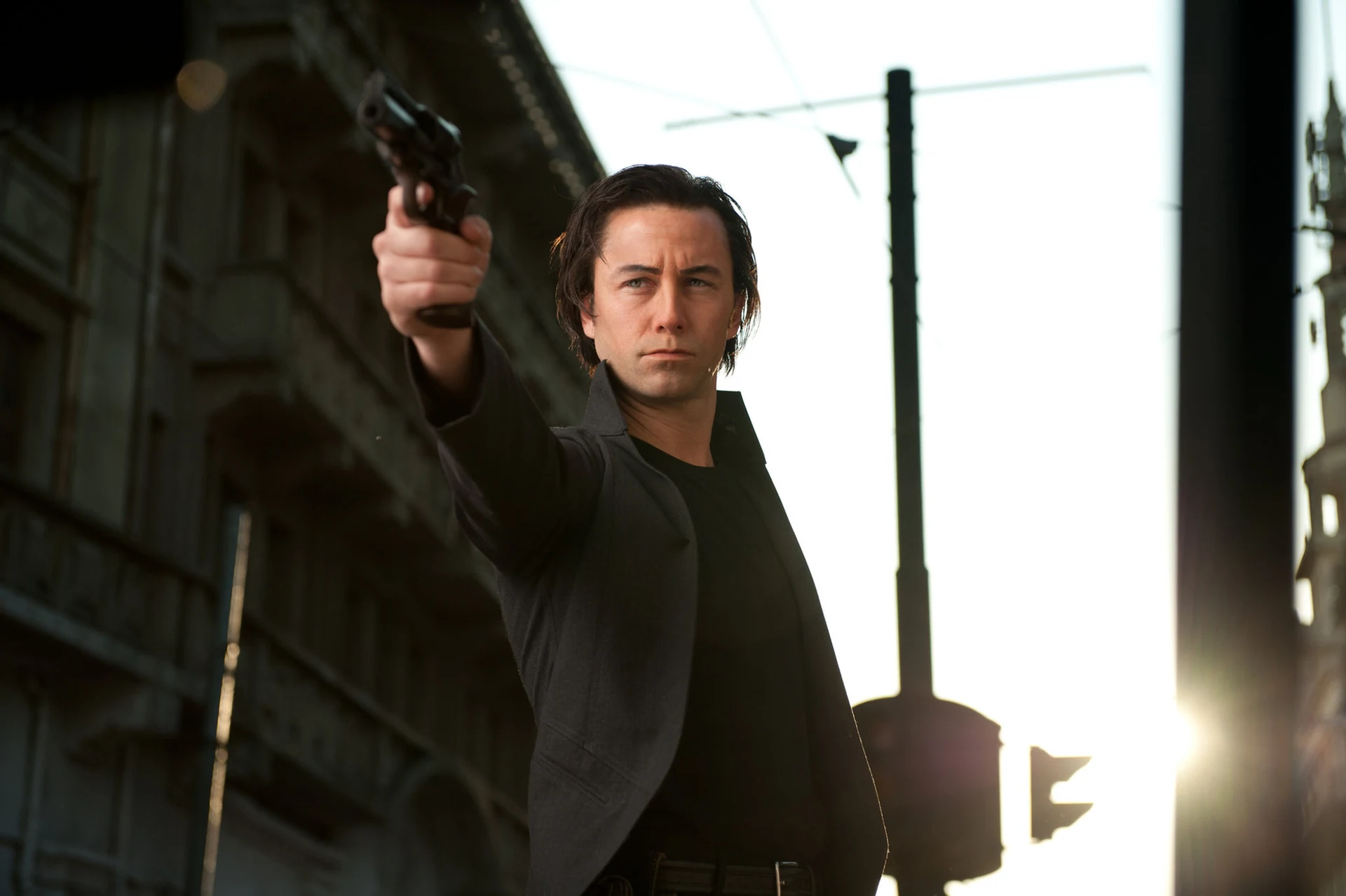
Still from 'Looper (2012)'. Photo credit: Alan Markfield/TriStar Pictures
Joe Versus His Future Self
The most prominent antagonist in Looper is Old Joe, who is the future version of the protagonist. Old Joe is a non-traditional villain, played by Bruce Willis, who is not greedy or lusting after power. Rather, he is motivated by love, sorrow, and desperation. When his wife is killed by the criminal empire of the Rainmaker, Old Joe avoids being executed in the future and goes back in time to kill the Rainmaker as a child, preventing the syndicate from coming into existence.
This renders Old Joe a very tragic villain. His reasons are decipherable, even empathetic. He is not attempting to control the world or make himself rich. He is making an effort to preserve one important relationship in his otherwise vacant life. However, in the movie his behavior is presented as morally disastrous. Old Joe also represents the worst side of utilitarian thinking by deciding to murder children in an attempt to preserve his own happiness.
What makes this contrast even stronger is the fact that Young Joe cannot simply dismiss Old Joe as evil. He looks at him as his own potential future. The habits, the cynicism, the loneliness, and the dependence on violence are all reflected across time. Old Joe plays the role of antagonist and warning. He is the result of the present decisions of Young Joe, made permanent.
Their war is thus philosophical as much as it is physical. Old Joe is of the opinion that he is bound to go through pain, and that whatever pain is prevented in the present justifies whatever atrocity occurs in the future. Much of this worldview is shared by Young Joe at the beginning of the film. However, over time he has to face the notion that it is morally deadening to preserve oneself at all costs. He is actually struggling against the idea that he cannot do anything to transform while fighting Old Joe.
The Rainmaker as an Invincible Menace
The Rainmaker is a near-mythical villain suspended over Looper. He is not a character, but rather a prophecy for most of the film. He is outlined as a future crime lord who will break the loopers and take over the underworld. His absence from the screen affects the behavior of all key actors.
This plot device is essential. The film makes the Rainmaker an inevitable figure by keeping him largely inconspicuous. He is a symbol of the terror of a predetermined future, of violence breeding violence, and of how systems of power reproduce themselves whether one wants them to or not.
It is, of course, revealed through a twist that the Rainmaker is not born evil. He is created. Once it is uncovered that the Rainmaker might be Cid, a traumatized child with great telekinetic abilities, the antagonist becomes not a villain but a moral quandary. It is no longer a question of how to stop the Rainmaker, and the only way to be sure that he does not exist is to stop him through murder.
In this respect, the Rainmaker is not an antagonist with agency, but one with potential. He turns out to be a mirror of the results of cruelty. The more bloodshed perpetrated in his name to stop him, the more he is propelled toward becoming what is feared. Looper applies this paradox to the rationalization of preemptive violence, which finds strong echoes even outside the science-fiction context.
Cid and the Frailty of Innocence
Cid is arguably the most disturbing antagonist character in Looper, since he is not a villain. He is a scared child molded by mistreatment, abandonment, and terror. His telekinetic power makes him a threat, but his emotional fragility makes him tragic.
What causes Cid to act as an antagonist is not his will but his surroundings. Raised by an abusive guardian and traumatized by violence committed in front of his eyes, Cid is constantly pushed toward emotional extremes. According to the film, power alone is disastrous without mercy. The powers that Cid possesses amplify his suffering and turn moments of fear into moments of destruction.
Cid, unlike Old Joe, has yet to decide which path to follow. He exists at a crossroads. It is here that the antagonistic structure of Looper becomes deeply ethical. Young Joe would stop future atrocities by killing Cid, but he would also eliminate the chance of redemption. To save Cid’s life would be to risk unimaginable damage, but it would prove the point that people are not defined by their worst possibilities.
The appearance of Cid forces the audience to confront uncomfortable questions concerning determinism and responsibility. Does one commit a crime before it has been committed? Is power corrupting by nature? Or must violence be taught, modeled, and normalized before it becomes inevitable?
The True Antagonist: the System
In addition to its individual characterizations, Looper depicts a larger, system-wide antagonist in the criminal economy that facilitates time-travel executions. The loop itself is an organization designed to remove responsibility. Outsourcing murder to the past relieves the future of its moral burden.
At the beginning of the film, Joe participates in this system without doubt. He murders people he does not know, desensitizing himself through drugs and routine. The system thrives on separation. Victims remain nameless, consequences are delayed, and moral accountability is deferred.
This arrangement creates Old Joe, the Rainmaker, and the cycle of violence that defines the movie. It favors short-term survival over long-term responsibility. By doing so, Looper argues that the worst enemy is not a single evil man, but a system that legitimizes violence.
Destroying the loop is thus both literal and symbolic. When Young Joe ultimately decides to die, he is not only putting Old Joe to rest. He is repudiating the system that brought both of them into existence. His death is a moral protest against fate.
Hostility as Moral Pressure
What makes Looper stand out among more traditional science-fiction thrillers is its unwillingness to simplify antagonism. Every antagonistic force in the movie applies pressure along a moral fault line. Old Joe tests love against selfishness. The Rainmaker embodies fear of the future. Cid challenges innocence and guilt. The system exposes the cost of moral convenience.
None of these antagonists can be defeated with a gun alone. They demand a decision, and every decision carries irreversible consequences. Looper ultimately suggests that antagonism cannot simply be erased, but must be confronted and endured. Conflict reveals who we are when mere survival is not enough.
In the end, time travel is not the true subject of Looper; moral causality is. Violence creates violence. Fear creates monsters. The possibility of change is rooted in compassion, even though it is fragile. Looper offers a pessimistic yet powerful reflection on responsibility in an escape-driven world by creating antagonists that are emotionally, philosophically, and structurally intertwined with its hero.