Receiving written feedback on a screenplay can be exciting and nerve wracking at the same time. You finally get to see your script through someone else's eyes, but you might also find comments that sting, contradict each other or seem to miss the point entirely. Knowing what to do with those notes is a skill in its own right, and it is one that many writers never learn.
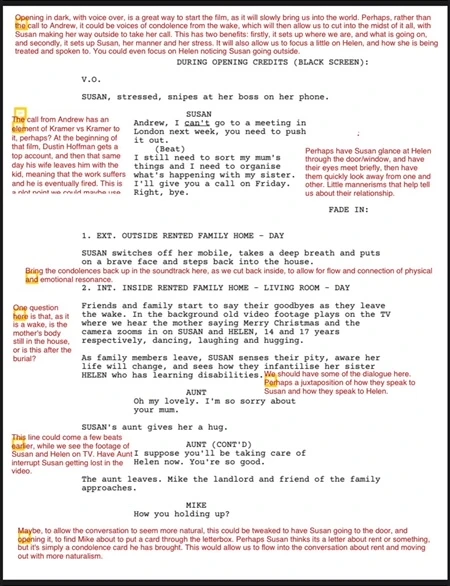
Annotated notes from one of our readers. See our script rewriting services.
Used well, contest feedback can show you exactly why a script is stalling in the early rounds and how to push it further next time. Used badly, it can send you into endless rewrites that make the script worse. Here is how to get the most out of the notes you receive.
Give Yourself Time Before You React
The first read of any feedback is rarely the most useful one. It is natural to feel defensive, especially about a script you have spent months or years on. Read the notes once, then put them away for a day or two.
When you come back, read them again slowly and assume the reader was trying to help. You will often find that comments which felt harsh at first are pointing at something real, even if the wording was blunt.
Separate the Problem From the Solution
Readers are usually very good at noticing when something is not working. They are less reliable at diagnosing exactly why, and their suggested fixes are just that: suggestions.
If a reader says the second act drags and suggests cutting a subplot, the useful part is the first half of that sentence. The second act drags for this reader. Cutting the subplot might be the answer, but so might raising the stakes, tightening scenes or giving your protagonist a clearer goal. Treat the note as a symptom and give yourself permission to find your own cure.
This is sometimes called finding the note behind the note. Ask what the reader felt at that point in the script, and why, rather than simply following their instructions.
Look for Patterns
One reader's opinion is one reader's opinion. But if two or three people, reading independently, flag the same scene, the same character or the same confusion, you can be fairly sure there is a real problem.
If you have feedback from several sources, such as more than one competition, a writing group and trusted friends, put the main comments side by side. Highlight anything that appears more than once. Those repeated notes should be at the top of your list, regardless of whether you agree with them at first.
On the other hand, a single comment that nobody else mentions, especially one about personal taste, can usually be set aside without much worry.
Sort Notes by Size
Not all notes are equal. A comment about a typo on page twelve and a comment that the protagonist has no clear goal are completely different kinds of problem, and they need to be tackled in a different order.
A useful approach is to sort every note into three groups. Big picture notes cover concept, structure, character arcs and stakes. Scene level notes cover pacing, dialogue, clarity and individual moments. Page level notes cover formatting, typos and line edits. Always start with the big picture. There is no point polishing dialogue in a scene that may not survive the next draft.
Pay Attention to Where the Reader Got Lost
Some of the most valuable feedback is not a note at all. It is a sign that the reader misunderstood something. If the notes describe a character's motivation incorrectly, mix up two characters, or misread a key plot point, that is not the reader's fault. It means the page did not communicate what you intended.
These moments are gold, because they show you exactly where your script is unclear. Go back to those pages and ask what information is missing, buried or ambiguous. Often the fix is small, such as a clearer introduction, a line of action or a moment of reaction from a character.
Know What the Scores Mean
Many competitions include scores or ratings for categories such as concept, structure, character and dialogue. These can be useful, but they are not precise measurements. Different readers score differently, and a single point either way rarely means much.
Look at the shape of the scores rather than the exact numbers. If your dialogue consistently scores higher than your structure, that tells you where to focus. If one category is far lower than the others, it may be the reason the script is not advancing.
Protect What Is Working
Feedback tends to focus on problems, but good notes will also tell you what is working. Pay just as much attention to those comments. They tell you what makes your script distinctive, and that is exactly what you need to protect while you revise.
It is surprisingly easy to fix every weakness a reader mentions and lose the voice that made the script stand out in the first place. Before you start rewriting, write down the three things readers liked most and keep that list next to you.
Make a Revision Plan
Once you have sorted your notes, turn them into a short plan. List the big picture changes first, then the scene level work, and finally the polish. Decide which notes you are going to act on and which you are going to leave, and write down why. If you want a structured approach to the rewrite itself, our article on how to approach revisions goes into more detail.
Give yourself a realistic deadline, ideally linked to the next competition you want to enter, so that the feedback turns into a stronger draft rather than an endless project.
Bringing It All Together
Contest feedback is one of the few chances you get to see your script through the eyes of a professional reader. Take time before reacting, look for the note behind the note, trust patterns more than single opinions, and fix big problems before small ones.
Above all, remember that the goal is not to please every reader. It is to make your script the clearest, strongest version of the story you want to tell. If you would like to see what detailed notes can look like, you can read our feedback sample.